Rye, New Hampshire: A Town at the Crossroads of American History, By Alex Herlihy
Book overview
The story of Rye is deeply American, shaped by its strategic coastal location. Native peoples lived here as early as 12,000 years ago, and Europeans arrived in the 1600s, establishing a community of farmers and fishermen. By the Revolutionary War, Rye numbered about 850 residents, some of whom marched on Fort William and Mary in 1774—the war’s first overt act.
The 1800s brought tourism and grand hotels, attracting presidents and dignitaries. In 1874, the first successful transatlantic cable came ashore just south of Locke’s Neck. The 20th century saw Rye’s population quintuple, spurred by WWII and steady coastal growth. Yet despite change, the town has preserved its rural character through conservation, historic homes, and winding roads. Today, Rye balances natural beauty with human presence, standing on the
shoulders of twenty generations. This book offers a sweeping companion to Langdon Parsons’ 1905 History of Rye, N.H., enriched by contributions from more than twenty voices.


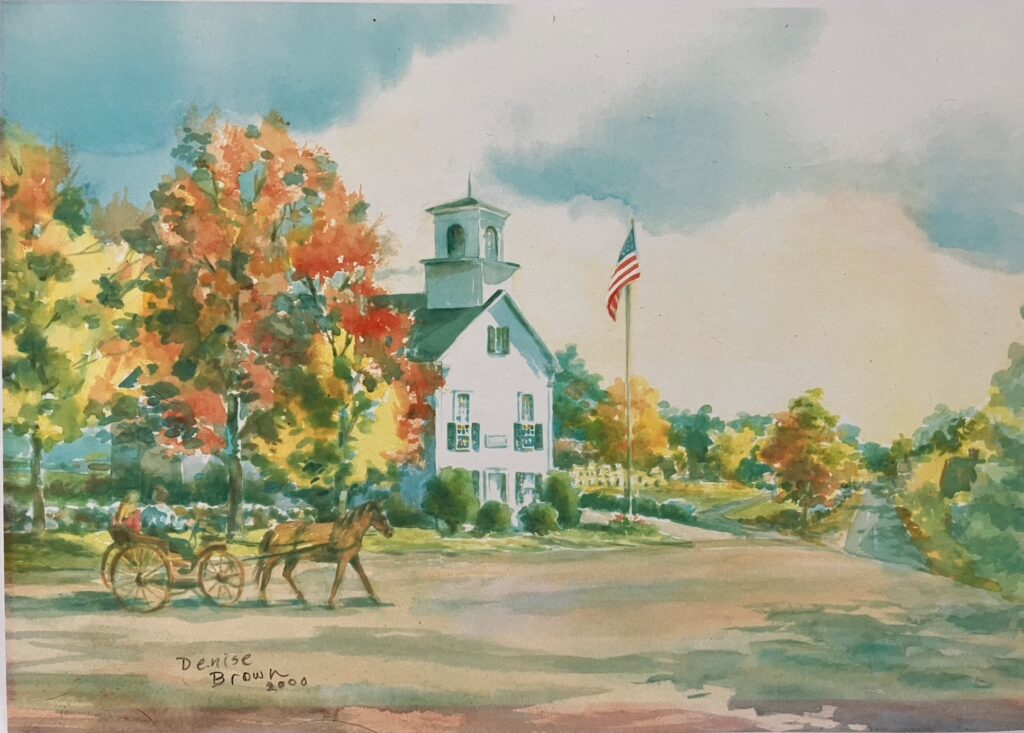
Courtesy of Rye Historical Society
How This New Rye History Came to Be
In 2000 I invited interested people to the library to see if we could start a joint project to update the town’s history. The project did not get off the ground because most people in the Rye Historical Society were focusing on getting the museum ready to open in 2002. So, I began regular visits to Ipswich MA where Rye historian Bill Varrell lived and I am grateful for all I learned from him. My RHS co-chair, Bonnie Goodwin, who oversaw the museum renovation and opening, was a wonderful friend and history partner to work with. She had a genuine interest in Rye’s past and I learned much from her. After she died in 2006 and Bill Varrell in 2007, I had lost two invaluable Rye history allies. Beyond Rye, I was fortunate to still have RHS charter members Becky Marden and Ralph Morang III, but I also had a steady stream of visitors to the museum who often had stories and information on Rye. By 2011, I had taken notes on all published sources and had read a lot of seacoast and New England history.
The real catalyst for this book happened in 2011 when I worked with Rye Elementary School to help narrate a Rye history trolley tour for 4th grade. For that tour I created a two-page Rye history time line. The success of that tour inspired RHS to begin our public history tours later that year. The time line soon grew to one hundred pages, thus creating a skeleton to begin a new Rye history. But it has been a very slow process because of other interests and demands on my time. Over the last decade I have spent more and more time talking with Roger Philbrick and have learned much from him through his research on many topics from Rye in the 1900s. The late Priscilla Jenness is another collector of Rye history which she faithfully shared with the public through the annual town reports.
When RHS treasurer Steve Cash joined the board in 2010, I gained a new partner because of his interest in early Odiorne Pt history. Local history author Tom Clarie showed up at the museum in 2011 and gave me an index to Bill Varrell’s “Rye on the Rocks that he had created using software. We became fast friends and he has been my biggest supporter to get this history done since that time. His “Oceanside History of Rye Beach and the Farragut”, 2013, was invaluable in writing my book because he used newspaper articles to document a century of
Rye history 1860’s – 1950’s. Tom printed out dozens of other Rye news articles for me to use during that time span. i.e., the KKK burned a cross on Wallis Road in 1926, etc.
I read all the town reports from 1863 to the present, incorporating selective information into the book. I also read non-published materials in the museum, including primary sources such as probate, militia, tax, deeds and other records, not to mention all the documents in our Access Rye History (1850-1920) collection on the RHS web site. I have included selective sections of these. Jessie Herlihy’s twelve Rye history poems, spanning the first three centuries,
can be found under the Topics Tab on this website under “Poems about Rye History.” Her “Growing up in Rye in the early 1800s,” Emma Foss letter of 1973 about the 1890s, excerpts from late 1800s diaries of Supply Foss Trefethen and George Lang are all found in the book. 20th century memoirs of Harry Lowell, Rolf Lium and David Mahar, Sandra Goss Munsey, Fred Clark, Priscilla Jenness and others round out contributions from almost twenty people past and present.
Those who have served on the board of the Rye Historical Society over the years as well as the staff of the Rye Public Library have also been stalwart supporters of this project, even as the book often seemed to be more of a dream than a reality. There have been countless people I have met at the museum and via e-mail who have made endless contributions to my knowledge. I now understand what I read in so many books about authors taking over a decade
to complete their book. They are so busy reading the works of others.
Knowing J. Dennis Robinson and reading his columns and books over the years has added greatly to my knowledge of seacoast history.
The most recent history person in my life is Hunter Stetz of Hampton Falls, who received his degree in archaeology from BU in 2015 and works part time researching, writing and giving tours for the Seacoast Science Center at Odiorne Point State Park. He is yet another “public historian” in my life, a term I came across a few years ago. It is an apt description for all of us, those whom I have mentioned and others, who care about and cultivate the history of their town and region. One does not have to be a trained academic scholar to be an historian. (See: National Council for Public History established in 1980).
The book has been copy edited by Roland Goodbody of Portsmouth, content edited by retired college history professor Weston Cook Jr. of Rye and retired English teacher Kay Morgan has edited several chapters. In 2023 the book images (160) were scanned by book designer Grace Peirce of Great Life Books who has been a long- time supporter of this project. It was Grace who referred me to book editor Tom Holbrook, former owner of River Run Bookstore, and his
wise editing has brought this project to completion. It has been a long and winding road of Rye history, but there is now light at the end of the tunnel.
Courtesy of Rye Historical Society